
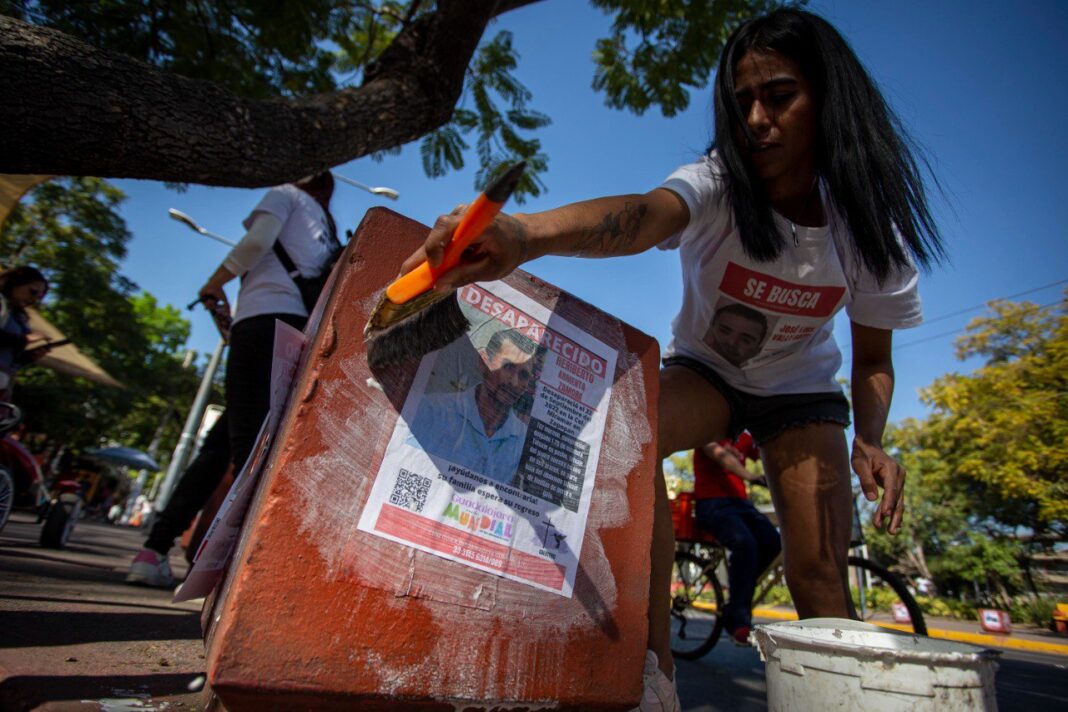
Data Cívica created a search engine titled “To Disappear Again” that helps make sense of the many inconsistencies in the Federal Government’s official records on the number of disappeared persons in Mexico.
It makes clear that there are around 10,000 names that appeared in 2018 lists and which no longer appear in the new 2024 list. It does not specify whether these people were found or why they were deleted, nor even the methodology used to create the database.
In reality, many of the people who stopped appearing in the 2024 registry were disappeared a second time, now on paper, and by the Mexican State itself.
By Ana Paula Carbonell Díaz / @AnaPauCarbonel1
For the last five years, Alicia Franco has been a data analyst at Data Cívica, where she has worked on projects related to militarization, democracy, and gender-based violence. She was the coordinator of the project “To Disappear Again.” Together with her team, she was in charge of cross-checking information among the confusing and poorly organized lists that the Federal Government provides to the public in order to keep a record of the number of disappeared persons in the country. In the process, they were able to confirm the existence of a large number of inconsistencies.
“We found a lot of missing information. Many deleted names. Many, many deleted names without explanation,” the analyst said in an interview with ZonaDocs.
Government publication timeline
Data Cívica reviewed and carried out scraping and matching of several data sources published by the Federal Government. Alicia stresses that the discrepancies between the data in the list published in 2018 and the one published in 2023 are the main focus of the “To Disappear Again” platform.
- 2017: The General Law on Forced Disappearance of Persons, Disappearance Committed by Individuals, and the National Search System for Persons (LGMD) orders the creation of a National Registry of Disappeared Persons, which was never made public beyond a name-based search tool.
- 2019: The first commissioner of the National Search Commission (CNB) publishes a database without names, and then resigns.
- 2020: The National Search Commission publishes the Public Version of the RNPDNO. It is not a downloadable database, and names cannot be searched.
- August 2023: A list is published with 110,964 names and basic data of disappeared persons, together with the resignation of Karla Quintana, then commissioner of the CNB.
- December 14, 2023: A “census” is published (though the term is misused, since the authorities did not go door to door asking whether anyone had a disappeared relative) under the name “National Generalized Search Strategy.” It includes 96,738 names, without any explanation for the reduction in the number compared to 2018.
Why the records matter
“The government really likes to call ‘records’ any publications that collect information, but that are not actually records,” Alicia warned.
Franco highlights how essential it is that records be rigorous, complete, and taken seriously, something the authorities responsible for compiling them usually fail to do. She lists the reasons why these records are so important for understanding the scale of the disappearance crisis and for contributing to the construction of memory, truth, and transparency for the public and for families:
They help clarify what is being counted when we count disappeared persons, and what is not being counted.
They are potential sources of information. A record must be used to generate tools to improve decision-making by the State and interested collectives.
Without good records, good decisions are not made. Records can show trends for better analysis and show how the phenomenon evolves over time.
The public has the right to hold the State and the government accountable for their actions. Without accurate records, we do not know what is being done, how it is being done, or what needs to be improved.
Main findings of the “To Disappear Again” platform
“I believe that the inconsistencies and the lack of information are serious omissions in and of themselves on the part of the State. It is their responsibility to address and prevent this serious violation of human rights. The State’s actions regarding the records have done the opposite; they have not helped the families,” explains Alicia Franco.
In this regard, the analyst points out that the so‑called “census” of disappeared persons published in December 2023 “does not specify the methodology used.” And although almost four months have passed since its publication, the Federal Government still has not made this information public, which she says is “incomprehensible.” On the other hand, the names and categories normally used in the records were not used, and therefore “it is not clear what is what, nor how the information was obtained,” the analyst noted.
In addition, Alicia warned that “the way the information is presented is not accessible.” Previously, files were provided in JSON format, a simple text format used by programmers that is not understandable for people without that prior knowledge. As a result, instead of clarifying doubts, the information creates confusion and fails to offer sufficient explanations for understanding issues as important as “why some people do not appear in future lists, whether they were found, or simply omitted.”
“This causes stress for searching families,” the analyst said.
How this platform helps searching families
Alicia Franco explains that this project was created primarily as an act of memory and support for relatives of disappeared persons in the country. People can use the platform in the following ways:
When accessing the platform, they can search for the name of the person they are looking for. Cards will appear for each disappeared person with that name or a similar name. They can also filter by state. On each card they will find the following information:
- Name of the person
- Whether it was possible to link the name to a unique search file number
- The identifier used in the variables of the databases to identify the person
- They can find resources on what to do if there is an inconsistency in their relative’s case.
- They can find a clear history of the records to help resolve confusion.
- All databases are accessible; they can be downloaded and used as needed.
Soon, the platform will allow users to review the records in which a person stopped appearing.
What’s next for the project
“We have spent six years demanding quality records and, in that regard, we do not see progress; sometimes we even see setbacks. So, despite having spent years on this and years demanding what is their legal responsibility, we do not necessarily see changes moving in the direction that could improve things for families and for disappeared persons,” insists the analyst in charge of developing this platform.
Finally, Alicia lists the actions that authorities should take regarding record‑keeping, transparency, and truth in the search for disappeared persons in Mexico:
- Publish a record that meets open data standards, where people are named and key variables for the search are shown.
- Keep records public even after a person is located. If we do not know who is being located, it is impossible to develop better search strategies.
- Publish a national registry of clandestine graves. So far, it has been citizen efforts that have produced anything close to this. The work of Quinto Elemento Lab is one of those efforts.
- Address the forensic crisis. Standardize fingerprint collection and ensure good communication among forensic, prosecutorial, and justice institutions.
The work of organizations and journalists such as Data Cívica and Quinto Elemento Lab, as well as collectives of relatives of disappeared persons, has made it possible to have at least a bit of clarity in the confusion the State creates, through the Federal Government and state governments with its lack of information, despite it being their responsibility to do this work correctly.
Correctly registering and documenting disappeared persons, beyond being crucial for their search, is also an act of dignity and respect.
***
Visit the “To Disappear Again” platform here.