
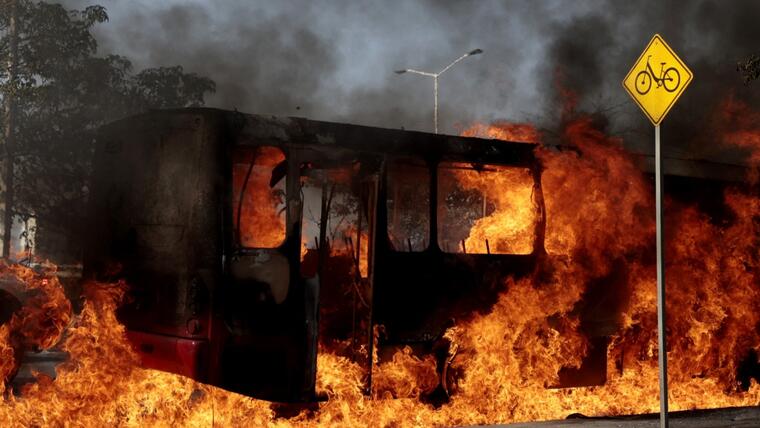
The news arrived on different screens and time zones, but with the same weight: the city was ablaze. While families in Guadalajara hunkered down due to roadblocks and gunfire, those living far away tried to piece together the map of fear with videos, audios, and messages that traveled faster than any certainty. Distance offered no peace, but rather a different kind of anguish: the anguish of not being able to be there.
By Ana Paula Carbonell / @anapau_24601 (IG)
‘Wouldn’t you rather be suffering with your family than being away from all of it and be fine?’ Antonio asks me on the phone, and I can hear the anguish in his voice. I immediately say yes, and it fills me with guilt. We both had to watch from afar as Guadalajara was engulfed in chaos, with nothing we could do about it.
Antonio has been living in Mexico City for almost six years, but his entire family is from Guadalajara. As he was finishing breakfast on Sunday morning to go to work, his roommate came up to him and said, ‘They killed El Mencho.’ He knew who he was and what it meant that he had been killed. He automatically checked the news on his phone, surprised by the number of videos of cars, buses, and buildings on fire. His father’s message to the family group chat came almost instantly, asking everyone to lock themselves in, no matter what, and not to go outside. There were waves of violence spreading throughout the city. Antonio had no choice but to ask them how they were doing as he left his flat so he wouldn’t be late for work.
I witnessed the 22 February events in Guadalajara from the future of the early hours of the 23rd, from the safety of my room in Hong Kong. I was about to go to sleep when I saw photo after photo on Instagram of burning cars and infographics showing which parts of the city’s roads were on fire, what parts to avoid. Roads I took every day for work or school, establishments I could immediately picture. And now I feel sorry because my first thought was that it was nothing serious; it’s not the first time there’s been a narco-blockade. It wasn’t until I read more about everything that was happening that I understood that this was much more serious, much more dangerous.
It feels awful to see everything from a screen so far away. Not knowing whether to feel relieved because you’re not there, the guilt that comes afterwards. My brother (who also lives abroad) and I contacted our parents, who assured us they were fine. That day, they were going to Chapala to see the lake with the pelicans, and if it weren’t for our messages, they would have gone out on the street. I imagine a lot of alternative scenarios where they left the house that Sunday, none of them good.
I could tell they were trying to downplay the situation, telling us to go to sleep, not to worry. It made me sad that even in those moments they wanted to protect us from the violence. I imagined the empty house, just the two of them, our cat and two dogs. If something happened while I was asleep, I wouldn’t find out until the next day. I fell asleep at 2 a.m., frantically refreshing Instagram and Facebook, trying to understand what was happening. I couldn’t believe it. I fell asleep thinking about cars on fire, about my city completely at the mercy of violence. I woke up barely rested, feverishly trying to catch up on what I had missed. It’s been horrible here, my mother texted.
While I was sleeping, Antonio was on the way to work, and he thought about his family. His mother with his grandparents in Santa Margarita, his father in San Agustin, his little sister alone at home, his other sister at a friend’s house. All scattered, each a different concern on his mind. A potentially catastrophic scenario. His uncle shared that the CJNG had announced that there would be narco-blockades, that they would capture anyone who was on the street. Although everyone told him they were safe indoors, he couldn’t calm down. The violent images only fuelled his imagination, the possibility that things could escalate even further.
‘I couldn’t stop thinking about how scared everyone was, because they heard gunshots and saw smoke through the windows. They were everywhere, and I was afraid they would break into houses and something even worse would happen. More than the fear, it hurt me not to be suffering with them, not to be experiencing the fear myself and having to settle for news reports, messages and images. I think that’s one of the worst things about living far away from your family.’
It’s scary to think that you live at the mercy of these people. That at any moment, if they decide to, they can paralyse the city. Antonio and I saw videos of Lopez Mateos, which we know for being congested at any time of the day, completely empty. The Minerva roundabout was deserted. It reminded me of the strange feeling we experienced during the pandemic, the silence, the abandonment. The government issued another red alert, sending everyone back home. Not because of a virus, but because it was physically impossible to go out without risking your life, your car. It’s a good thing you don’t live here, seriously. That’s what I’m saying right now, my mum wrote to me on Monday night.
One of Antonio’s uncles works in one of the airport towers. For hours they didn’t know anything about him, only the videos and news reports of the shooting that took place there on the 22nd. It wasn’t until nightfall that he let them know he was okay, that he had been It wasn’t until nightfall that I realised I was okay, that they had locked them in to protect them, that he was going to have to spend the night there. The videos from the airport, with people running after the sound of bullets, were the only thing on his mind. The amount of manipulated images and fake videos made it difficult to discern how serious the situation was. Neither on Sunday nor Monday could he concentrate on his work because of the uncertainty.
Most of my friends in Hong Kong had never heard of Guadalajara until I told them that’s where I’m from. And I didn’t want to tell them what was happening, for fear that they would think that was the only thing that existed in Mexico. I had been planning to go there in the summer with my flatmate for months. I thought that if I told her, she wouldn’t want to go anymore (I had no idea it would become international news, that everyone would ask me about it anyway). Then I felt anger and shame that this was my only concern when everyone in Guadalajara had no choice but to live through it. There was no other option.
Being far away from Guadalajara has been difficult because I can’t help but feel close to all its problems. Weeks ago, I was outraged along with everyone else by the (now very mundane) debate about the fare increase, public transport at 14 pesos, the famous card with which Lemus promised that every Guadalajara resident could buy a coffee in New York. With Antonio, who although physically closer is still far away, I have seen from the outside how these problems are growing. How sad it makes me that people deserve better. How I wish my parents didn’t feel so relieved that I’m no longer there.
Life goes on, despite the violence. From burned-out businesses and blocked roads, the sounds of screams and bullets, to having to go back to work two days later, as if nothing had happened. I wonder what it does to our collective psyche, to experience something like that and then having to go into the office and take meetings. Returning to the banality of everyday problems after the city was completely paralysed seems incredible to me, even though it is nothing new. We Mexicans normalise violence daily because we have no other choice. I hadn’t realised this until I had to explain it to someone who grew up without having to do so.